A Note on the Amelia Wilson Story, Authorship, and the Use of My Work by Charles Town Ghost Tours
A factual account of how my Amelia Wilson reporting was used, partially attributed after the fact, and publicly reframed by Charles Town Ghost Tours.

I do not usually write posts like this, and I would rather spend my time reporting than defending work that should speak for itself. But in this case, I think the record deserves to be clear.
My article on the 1969 murder of Amelia Wilson in Charles Town, West Virginia, was independently researched and written by me for Sad Endings. That reporting was not casual or derivative. It was built through archival newspaper research, original reporting, direct contact with Amelia Wilson’s family, and an original interview with her son. It also drew on materials from my case archive, family-provided media, and photographs published on my site.
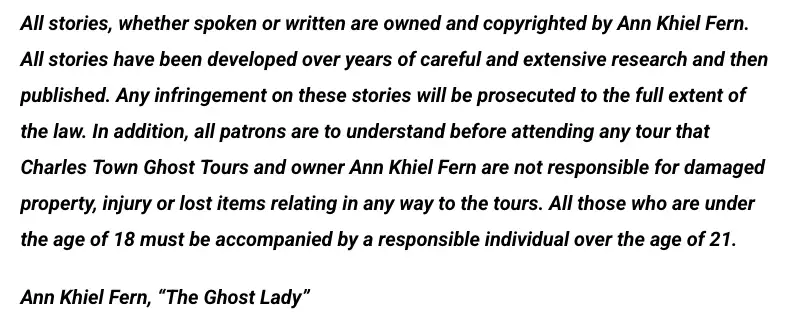
Recently, Ann Fern, who operates Charles Town Ghost Tours, a local ghost-tour business with an associated Facebook page, published a series of posts about the Amelia Wilson case. In one of those posts, Charles Town Ghost Tours stated in the first person, “I wrote about this case several years ago,” while presenting a detailed narrative of the case. In context, that wording created the impression that the page was presenting the story as its own write-up.
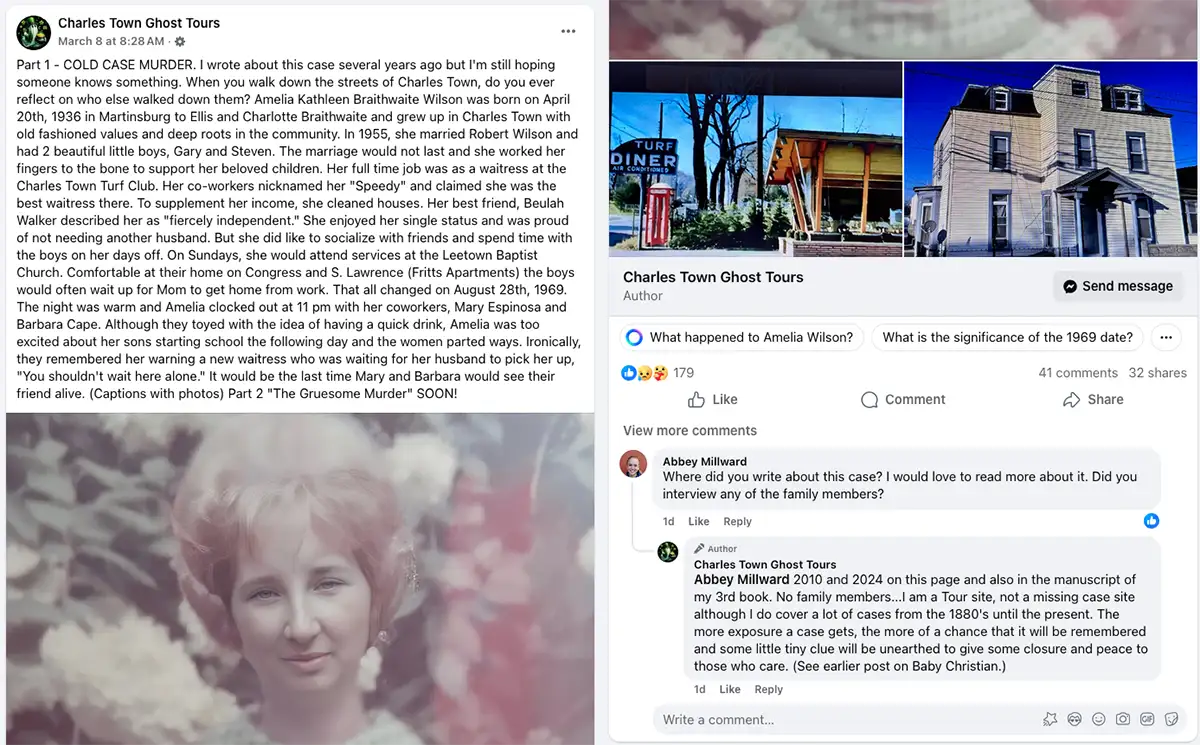
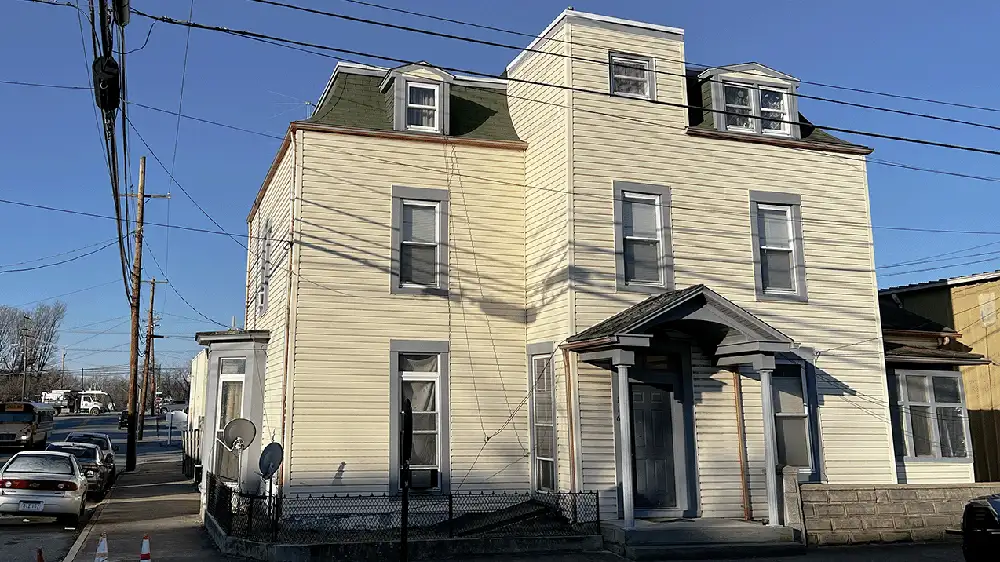
The post also drew on media associated with my reporting package, including my enhanced version of Amelia Wilson’s portrait, a vintage Turf Diner postcard I had sourced and published, and a photograph of the apartment building that I took myself.
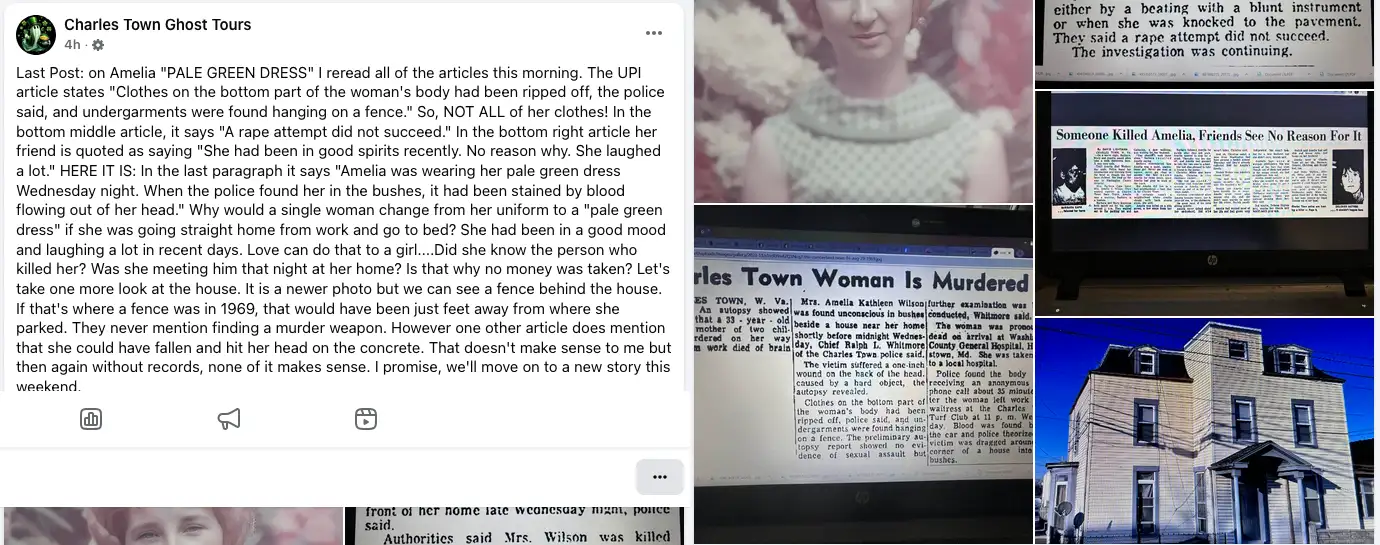
A later March 13 post pointed in the same direction. Rather than linking readers to any prior finished account, it showed Fern still working through basic source material and unresolved questions in public, including clothing descriptions, the fence, the reported rape attempt, and whether Amelia may have known her killer. In other words, the post read less like someone drawing from an established body of prior work and more like someone still piecing the case together from the archive while continuing to use media associated with my reporting.
My concern was not simply that someone else discussed the case. People are free to discuss public history and unsolved crimes. I publish archival research and make my research materials public whenever I can so others can follow the record for themselves. The issue here was never access to archives. It was the use of my reporting in a way that created an inaccurate impression about who had done the work. The overlap was not limited to broad facts available in old newspaper reports. It extended to the way the case had been reconstructed, assembled, and presented.
The first thing I did was leave a public comment on Fern’s initial post about Amelia Wilson asking for credit and linking to my article. That comment was promptly deleted, and my account was then blocked from viewing Charles Town Ghost Tours content directly on Facebook.”
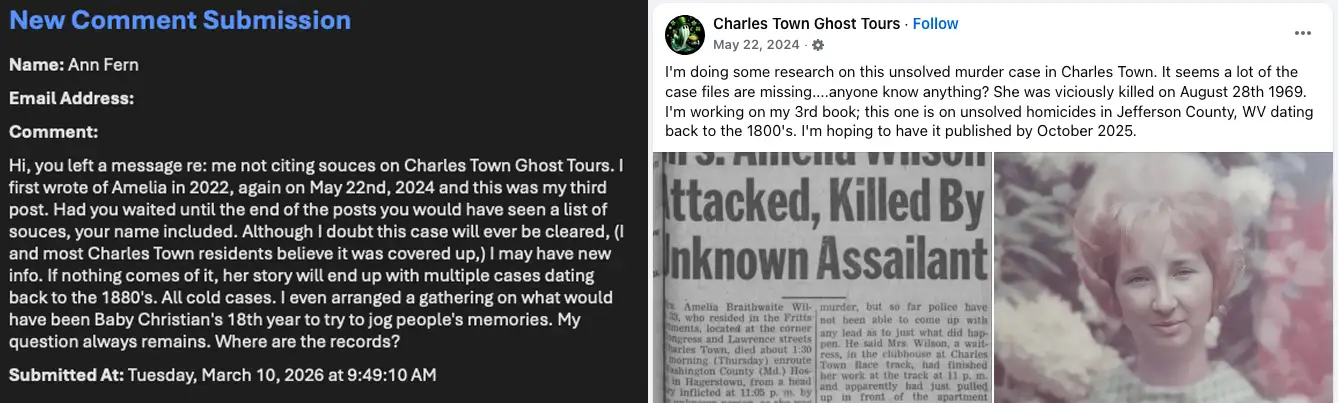
Fern’s first direct response came through a comment submission on my site. In it, she claimed she had first written about Amelia in 2022, again on May 22, 2024, and that the March 2026 post was her third. She also wrote, “Had you waited until the end of the posts you would have seen a list of sources, your name included.”
I then followed up by email and made clear that my objection was not simply about whether sources might be cited later. I told Ann Fern that her posts had created “an inaccurate impression about the authorship” of my Sad Endings article and that they had reused “at least one photograph I took, without permission or attribution.” In response, Fern wrote, “When I finish the post I will cite ALL sources as I have for many years.”
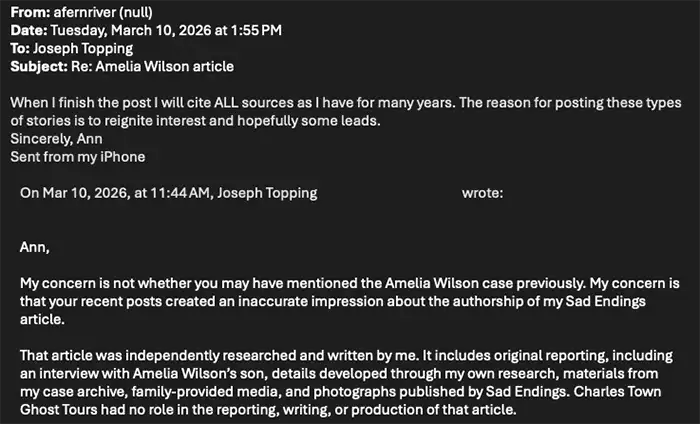
That response did not address the underlying problem. The issue was not whether sources might be listed later. It was that the posts had already created an inaccurate impression about the authorship and reporting behind my Sad Endings article while reusing at least one of my photographs without permission. To be clear, at least one of those images was my own photograph, republished without my permission. Other family-provided photographs were shared with me in the course of my reporting, not supplied to Charles Town Ghost Tours for reuse in its own posts.
Later, after I objected, Charles Town Ghost Tours added language acknowledging that quotes had been used from a blog by “J. Topping.” That confirms that my work was used. But the attribution came only after I raised the issue, not at the outset, when readers were first given the impression that this was the page’s own write-up. I also never used the name “J. Topping” in my communications. Using an abbreviated name instead of my published byline made the source harder for readers to identify and made my reporting more difficult to find.
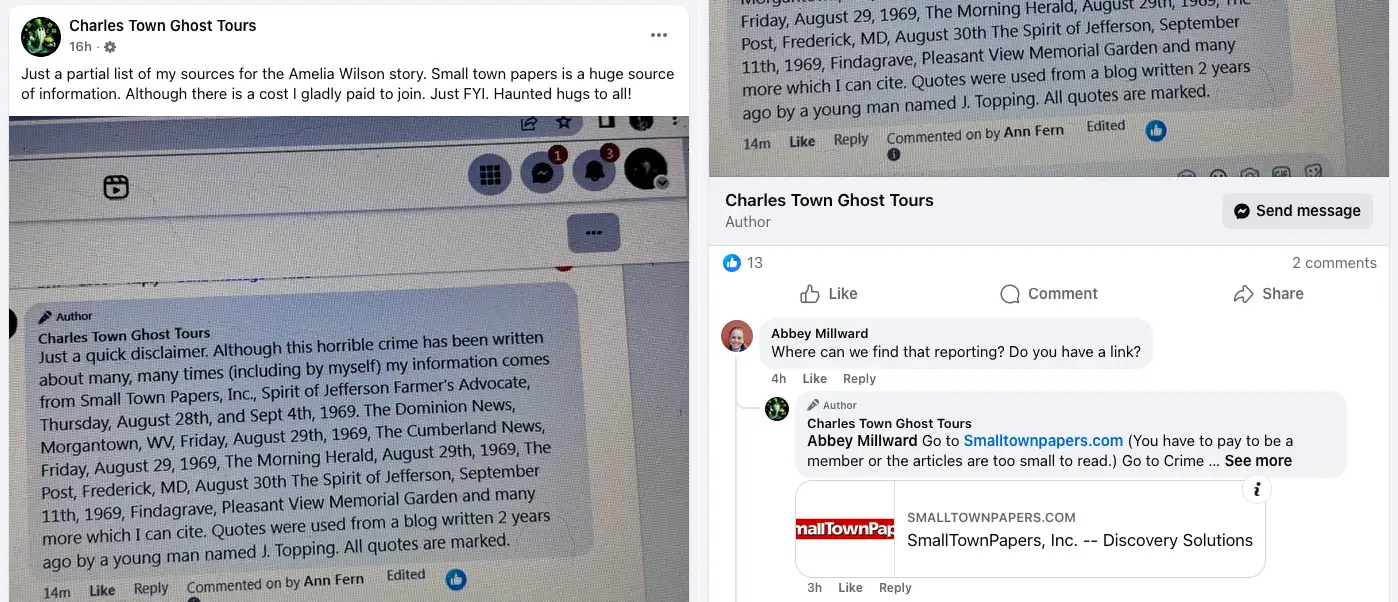
Even after that, when a commenter asked where the reporting could be found, Charles Town Ghost Tours did not plainly direct readers to my article. That comment exchange was later removed from the page, but I preserved a screenshot of it. Instead, readers were pointed to archive sources and other materials, as though the sourcing trail had simply appeared on its own rather than being located and assembled through my reporting. That is part of why I am writing this now. If my work was used, readers deserve a clear record of that.
The same problem appeared again in a later post about Gary Wilson. What troubled me there was not just the reuse of underlying information, but the way Fern inserted herself into the narrative of discovery. The post presented her as the person uncovering Gary Wilson’s apparent death, checking records, and pursuing follow-up with California authorities, even though the language and sourcing trail closely tracked material I had already assembled in my archive.
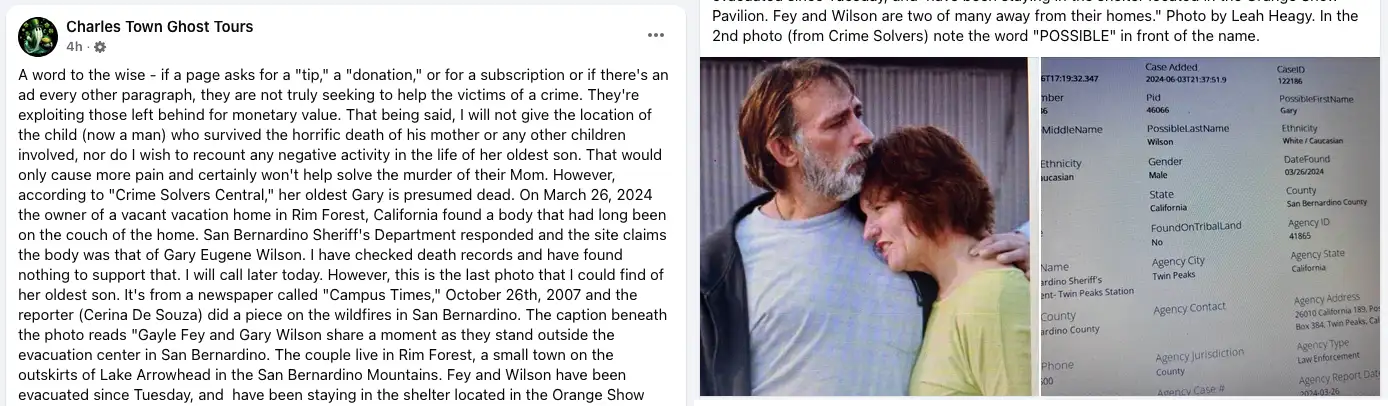
I also want to address one other aspect of this. In a later post, Charles Town Ghost Tours criticized pages that ask for “a tip” or “a donation,” suggesting that such support amounts to exploiting victims. I do not offer subscriptions, and in context I believe readers can judge for themselves what that comment was meant to imply.
That criticism is especially striking because the families I work with have willingly participated in my reporting. They have sat for interviews, shared photographs, and entrusted me with material connected to their loved ones. At least one photograph I took was later republished by Charles Town Ghost Tours without my permission, and family-provided material shared with me for reporting was later used by the page as part of its own presentation of the case.
I also reject any implication that this work was somehow detached from the interests of Amelia Wilson’s family. It was done with their willing participation and trust. More than that, it had a real-world effect: through my research, I was able to help reconnect surviving family with information about Gary Wilson’s remains after he disappeared in 1984. That is not exploitation. It is one example of what serious, careful reporting can make possible. It is also why some of Fern’s later commentary struck me as especially misplaced. She was stepping into sensitive family matters without understanding my ongoing relationship with Amelia Wilson’s family or the context in which this work was done.
I have no issue defending a tip jar attached to original reporting. This work involves real costs, including hosting, records requests, and many hours of research and writing. There is a meaningful difference between doing that work and asking readers to support it, and repackaging that reporting while taking swipes at the person who did the work and using the case itself to generate attention for a business.
Timeline of My Reporting and the Later Dispute
This timeline shows when my research and reporting on the Amelia Wilson case were published, what Charles Town Ghost Tours later claimed about prior writing on the case, and when posts appeared that prompted this authorship dispute.
I began building my public Amelia Wilson research archive.
My Amelia Wilson article was published on Sad Endings.
Charles Town Ghost Tours published a brief research note about the case, not a developed write-up, while already using media that had appeared in my article.
Charles Town Ghost Tours published a brief research note about the case, not a developed write-up, while already using media that had appeared in my article.
I published a follow-up article with new information on the case.
Through this research trail, I was able to help provide surviving family with information about Gary Wilson’s remains and the process surrounding them.
Charles Town Ghost Tours posted, “I wrote about this case several years ago,” while presenting a detailed narrative of the case.
Additional posts followed using overlapping details, narrative structure, and media.
I raised concerns privately about authorship and the unauthorized reuse of my photograph.
In her response, Ann Fern claimed she had previously written about Amelia in 2022, again on May 22, 2024, and that the March 2026 post was her third. After a thorough review of the Facebook feed, I found no such post from 2022. Charles Town Ghost Tours also added a partial attribution to “J. Topping.”
When asked where the reporting could be found, the page still did not plainly direct readers to my article.
A later Charles Town Ghost Tours post showed Fern still publicly working through basic source material and unresolved questions about the case while continuing to use media associated with my reporting. My archive URL was also visible in the screenshots shown in the post.
I am not claiming ownership over the historical fact of Amelia Wilson’s murder. No one owns history, and no one owns a public case file. But original reporting does matter. The work of locating archives, assembling a narrative, contacting the family, conducting interviews, verifying details, and publishing a coherent account is real work. That work is the product. When that product is used in a way that blurs authorship or downplays its origin, it has a real impact.
So let me state the facts plainly.
I independently researched and wrote the Amelia Wilson article published on Sad Endings. When I reported that story, I was not working from any substantial modern write-up of the case. As best I could determine through my own research, the available record consisted mainly of archival newspaper coverage and brief reference material, not a detailed modern narrative. Charles Town Ghost Tours did not write, report, or contribute to that article.
It includes original reporting, including an interview with Amelia Wilson’s son, materials from my case archive, family-provided media, and photographs published by Sad Endings. Any implication that Charles Town Ghost Tours authored that article or its original reporting is inaccurate.
I am writing this not because I enjoy disputes like this, but because authorship matters, attribution matters, and original reporting matters.
Expand for a point-by-point comparison of my reporting and the later Charles Town Ghost Tours posts
Authorship framing
My reporting: My article appeared on Sad Endings under my byline.
Charles Town Ghost Tours: The first post said, “I wrote about this case several years ago.”
Why it matters: That wording gave readers the impression the write-up was theirs.
Original reporting
My reporting: My article was built from archival research, family contact, and an original interview with Amelia Wilson’s son.
Charles Town Ghost Tours: When asked about interviews, the page said, “No family members... I am a Tour site, not...”
Why it matters: There is a difference between original reporting and later retelling.
Detail and structure
My reporting: I assembled a detailed reconstruction of Amelia Wilson’s life, last night, death, and family history.
Charles Town Ghost Tours: The posts followed the same general narrative arc and many of the same details.
Why it matters: The overlap was not just factual. It was structural.
Distinctive details
My reporting: I brought together many specific details into one coherent account.
Charles Town Ghost Tours: The posts repeated details including Amelia’s work at the Charles Town Turf Club, her nickname “Speedy,” co-worker names, the warning not to wait alone, the Fritts Apartments, and sons Gary and Steven.
Why it matters: Any one detail might exist in archives. This many overlapping details point to the same reporting trail.
Use of my work
My reporting: My article was publicly available under my byline.
Charles Town Ghost Tours: After I objected, the page added: “Quotes were used from a blog written 2 years ago by a young man named J. Topping.”
Why it matters: That is an acknowledgment that my work was used.
Timing of attribution
My reporting: My article was mine from the moment it was published.
Charles Town Ghost Tours: The acknowledgment appeared only after I raised concerns privately.
Why it matters: The attribution was reactive, not upfront.
How I was identified
My reporting: My byline is Joseph Topping.
Charles Town Ghost Tours: The page referred to me as “J. Topping” and “a young man named J. Topping.”
Why it matters: That made the source less identifiable and harder for readers to find.
Directing readers to the reporting
My reporting: Readers could find my article directly on Sad Endings.
Charles Town Ghost Tours: When asked for a link, the page sent readers to archives, other sites, and Google, then shifted into comments about events and books instead of plainly directing readers to my article.
Why it matters: Even after acknowledging my work, the page still did not clearly point readers to it.
Use of media
My reporting: My reporting package included family-provided media, case-archive materials, and photographs published on my site.
Charles Town Ghost Tours: The posts used overlapping media, including at least one photograph I took and that was republished without my permission.
Why it matters: The issue was not just text. It included my media as well.
My private objection
My reporting: I told Ann Fern that the problem was the inaccurate impression of authorship and the reuse of my photograph without permission.
Charles Town Ghost Tours: Fern replied, “When I finish the post I will cite ALL sources as I have for many years.”
Why it matters: I raised authorship and photo use. She answered with future citation.
Support and motive
My reporting: My site includes a tip jar to help support original reporting and research costs.
Charles Town Ghost Tours: The page criticized sites that ask for “a tip” or “a donation,” while using this case to generate attention for a commercial ghost-tour brand.
Why it matters: That reads less like principle than a swipe at the person who did the work.
Readers can draw their own conclusions. Mine is simple: this was my reporting, my work was used, and the attribution came only after I raised the issue.
And finally, I will simply leave this here.